Thursday, April 29, 2010
generational marketing-the tween market.
Social Class.
- B= Middle class


Oh dear....
Sunday, April 25, 2010
Gender.
Ah, the age old saying: Men are from Mars, Women are from Venus. Which in my opinion couldn't be more true! You just have to look to the men in our modern society, well known jokes and riddles refering to men and their ways- It's been even been proven scientifically! It's been stated that Women tend to think with the right side of their brain which is the more visual, creative and intuitive side of their brain, whilst men often think with the left side of their brain, which is very the basic, more "to the point using logic" side of their brain. check out this video we watched in class! Its a humerous look into how different men and women really are!
** http://www.youtube.com/watch?v=GuMZ73mT5zM- a satorical look at the differences between the male and female brain by Mark Gungor. **
gender differences within advertising
Gender differences within advertising has been researched by Schiebe & Condry (1984). Advertisements were analysed according to the type of product being advertised and it was found that the values being promoted within advertising aimed at male and female audiences differed significantly. It was found that that advertisements aimed at females centered around the importance of health, beauty and vitality, whilst advertisments aimed at men centered around the inportance of physical strength and and ambition.
one notable example of this I found were these 2 adverts by prolific fashion house, Dolce and Gabanna. Each of these adverts are aimed at a male and female target audience.:

note that the mens advert is kept simplistic, and to the point: just as we discussed earlier about a mans behaviour and way of thinking! The use of actor Matthew Mconahay- a common staple in films aimed at a male target audience as well as the stereotypical ideal of the "strong, masculine male- could also be a form of "aspirational advertising" for the male target audience. Also note how monotone and simplistic the mise-en-scene, lighting and colours used are as well! However, the female one uses a lot of shades and colours and there is a lot going on in the background. The ensambles worn for the print ad are visable to the eye: perhaps a play on womens' ability on focusing on every detail- thus a lot of sales and a very happy fashion house! I believed that these 2 print adverts are a good example of the theory, as one promotes strength and masculinity, whilst the other promotes beauty and vitality. It also demonstrates how the mae and female mind differ in terms of thinking when something is presented to them.
Interestingly enough, we often see items for males targeted at a female audience- a clever ploy adapted so that women can indulge their significant others in the said item- again, leading to a very happy company (:
In class we conducted two interesting experiments. The first experiment involved looking at this picture:

As a class, we were asked to highlight what we spotted in the picture, after viewing it for a brief moment. Here are a copy of my class notes, highlighting what I spotted and stored within my memory after those few minutes:
*telephone on desk
*2 chairs on either side of the desk
*painting in the background
*the round carpet
*the windows and doors on the right had side
*the two sofas in the background
*the two lamps in the background
*the big grandfather clock on the right hand side near the window and door
*the fireplace at the back of the room
*I even went as far as to create a scenario as to what the room is for: my conclusion? it very much looks like the room that could be situated in a place such as the white house!
this experiment was conducted to back the theory that females often pay attention to small detail and are able to cite a lot of things from memory, as opposed to their male counterparts that often just spot the more "apparent" rather then looking deeper and focusing beyond that.
we were then asked to view the following television adverts:
http://www.youtube.com/watch?v=blWd3iixIJc- An advert for charity organisation Banardos
http://www.youtube.com/watch?v=RMwt28P_xSQ- An advert for another charity organisation Cancer Research UK.
http://www.youtube.com/watch?v=tijSx_fwoM0 - An advert for give blood.
after viewing each advert, we had to discuss which charity organisation we were most moved by emotionally. I personally (as well as the majority f the females in the class) chose both Banardos and Cancer Research UK as having the most impact on me emotionally. This is due to the fac that as females, we tend to use the right, more emotional side of our brain. The males were more swayed to the give blood advert, which did not evoke any emotion, but instead was straight to the point in explaining what the charity organisation is and what you can do to help.
In conclusion, what have we learnt today? That men are from Mars, and women are definately from venus (:
Useful link of the day!- http://www.bbc.co.uk/science/humanbody/sex/add_user.shtml
An interesting test to show you whether you have a "male" or "female" brain! Try it- the results could shock you! (mine did, even though my brain was mostly that of a "female" one, it was found that I do indeed possess some male thinking chracteristics!)
XOXO.
Enterprise week :)


Perception: Social Experiment.


Friday, October 16, 2009
week three...
Today, we had an interesting lecture, regarding Kolters' buying decision process. For those of you who have not heard of Kolters process, it is a step by step process that defines how the typical consumer might make thier decision about purchasing a product. It is said to go like this:
need recognition ---> Info Search ---> Evaluation of alternatives ---> purchase decision ---> post purchase behaviour.
for those of you who don't understand it think of it this way: Say you are going food shopping, and you are looking for tomato Ketchup. you go to the aisle in which ketchup is kept (which is step one: needing recognition). You are then introduced to a whole array of of tomato ketchups, yet you cannot decide which one to get. You decide to find which one is best for value (step teo, information search). You then look at the different ketchups and evaluate the alternatives. You then have reached your decision and go to the checkout. (Purchase decision/Post-purchase behaviour.)
However, it is claimed that the model is not 100% foolproof. the model may be altered by impulse purchasing, when something of better value is spotted, etc. Also, brand loyalty may effect the model as well, as the consumer knows what they want, and does not have to go through the 5-step process.
Now we have covered Kolters Buying decision process, we can move onto "the percieved Risk Model", which was proposed by Harvard Business School in the mid- 60's. behaviour is said to depend upon an individuals subjective perception of the risk inheret in buying a product. It is important ot note that peoples torelence to risk varies- in this case according to the target audience. The model also can also depend on the level of the product, rather then the individual. Measuring involvement is also important. Laurent and Kapferer (1985) argue thyat a consumers level of involvment will be affectedby the following 5 componetents: Finance, Time, Performance, Ego, Physical and Social.
Perceptual Set and Mapping.
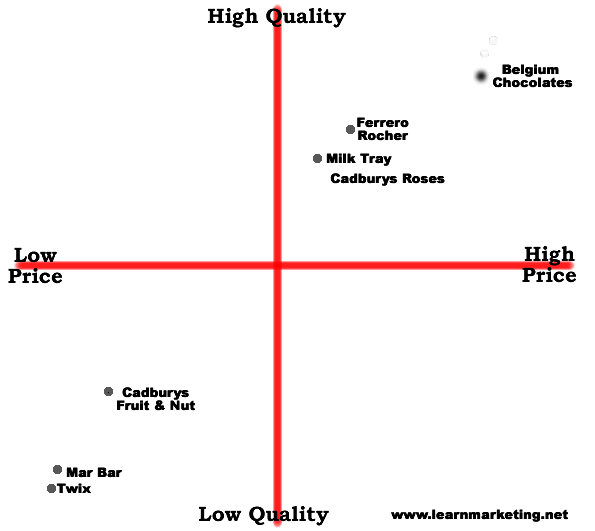
We also discussed what is known as the perceptual set. this is when " the individual develops a persistant and deep rooted way of perceving, thinking and believing". (Vernon, 1955). To explain this in shorter terms think of the well known phrase "we are set in our ways". The perceptual set can also work as a selector and interprater. Perceptual Mapping is a graph used by marketers to show the consumers opinion on different products. Usually the brand name or product is placed on the map according to the popularity of the product. This graph determines what brands should be considered competition. Heres an example of a perceptual map. http://www.learnmarketing.net/perceptualmap.gif
Gelstat Psychology
The Gelstat School of Psychology is a theory that was created to explain how we interpret the world around us, and uses what is known as "Figure and Ground". The figure is the central element which captures our attention, whilst the ground is the background. the ground is then made obsulete because of the central focus. For example, look at this optical illusion http://gryphonscry.files.wordpress.com/2009/02/optical_illusion.jpg. What is the first thing you see?...
consumer psychology
Heres an interesting interview I found on YouTube with Harvard School of Business Professor John Quelch, which discusses how consumer psychology has been affected by the current recession and how companies can overcome this obstacle.

Stimulus Ambiguity.
Lastly, we Discussed Stimulus Ambiguity. This is when something that is odd or out of the ordinary is presented before us and we have to make sense. This campaign produced in the 1970's is a good example of Stimulus Ambiguity.
Here are a few useful links regarding this weeks lesson!
http://www-rohan.sdsu.edu/~renglish/370/notes/chapt05/
http://www.learnmarketing.net/perceptualmaps.htm
http://www.eyetricks.com/illusions.htm
Thursday, October 1, 2009
WEEK ONE...