Today, we had an interesting lecture, regarding Kolters' buying decision process. For those of you who have not heard of Kolters process, it is a step by step process that defines how the typical consumer might make thier decision about purchasing a product. It is said to go like this:
need recognition ---> Info Search ---> Evaluation of alternatives ---> purchase decision ---> post purchase behaviour.
for those of you who don't understand it think of it this way: Say you are going food shopping, and you are looking for tomato Ketchup. you go to the aisle in which ketchup is kept (which is step one: needing recognition). You are then introduced to a whole array of of tomato ketchups, yet you cannot decide which one to get. You decide to find which one is best for value (step teo, information search). You then look at the different ketchups and evaluate the alternatives. You then have reached your decision and go to the checkout. (Purchase decision/Post-purchase behaviour.)
However, it is claimed that the model is not 100% foolproof. the model may be altered by impulse purchasing, when something of better value is spotted, etc. Also, brand loyalty may effect the model as well, as the consumer knows what they want, and does not have to go through the 5-step process.
Now we have covered Kolters Buying decision process, we can move onto "the percieved Risk Model", which was proposed by Harvard Business School in the mid- 60's. behaviour is said to depend upon an individuals subjective perception of the risk inheret in buying a product. It is important ot note that peoples torelence to risk varies- in this case according to the target audience. The model also can also depend on the level of the product, rather then the individual. Measuring involvement is also important. Laurent and Kapferer (1985) argue thyat a consumers level of involvment will be affectedby the following 5 componetents: Finance, Time, Performance, Ego, Physical and Social.
Perceptual Set and Mapping.
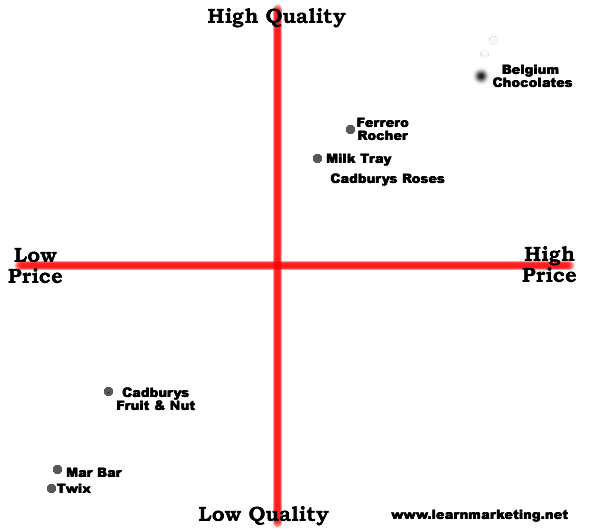
We also discussed what is known as the perceptual set. this is when " the individual develops a persistant and deep rooted way of perceving, thinking and believing". (Vernon, 1955). To explain this in shorter terms think of the well known phrase "we are set in our ways". The perceptual set can also work as a selector and interprater. Perceptual Mapping is a graph used by marketers to show the consumers opinion on different products. Usually the brand name or product is placed on the map according to the popularity of the product. This graph determines what brands should be considered competition. Heres an example of a perceptual map. http://www.learnmarketing.net/perceptualmap.gif
Gelstat Psychology
The Gelstat School of Psychology is a theory that was created to explain how we interpret the world around us, and uses what is known as "Figure and Ground". The figure is the central element which captures our attention, whilst the ground is the background. the ground is then made obsulete because of the central focus. For example, look at this optical illusion http://gryphonscry.files.wordpress.com/2009/02/optical_illusion.jpg. What is the first thing you see?...
consumer psychology
Heres an interesting interview I found on YouTube with Harvard School of Business Professor John Quelch, which discusses how consumer psychology has been affected by the current recession and how companies can overcome this obstacle.

Stimulus Ambiguity.
Lastly, we Discussed Stimulus Ambiguity. This is when something that is odd or out of the ordinary is presented before us and we have to make sense. This campaign produced in the 1970's is a good example of Stimulus Ambiguity.
Here are a few useful links regarding this weeks lesson!
http://www-rohan.sdsu.edu/~renglish/370/notes/chapt05/
http://www.learnmarketing.net/perceptualmaps.htm
http://www.eyetricks.com/illusions.htm